Inside the Cancer AI Alliance: Dr. Srinivasan Yegnasubramanian on a proactive vision of cancer care
Inside the Cancer AI Alliance is an interview series where we take you behind the scenes of our work, looking at how we are bringing together the nation’s leading cancer centers and technology leaders to unlock the power of AI via federated learning.
In this interview, we feature a conversation between Brian M. Bot (Director of the Strategic Coordinating Center for CAIA) and Dr. Srinivasan “Vasan” Yegnasubramanian (Professor at Johns Hopkins and Director of inHealth Precision Medicine). They discuss CAIA’s beginnings, our federated learning model to enable cross-institutional cancer research, and how we can move to a more proactive form of care.
Dr. Vasan Yegnasubramanian is a physician-scientist who lives at the intersection of biology and data. He spends his days looking at how we can take the massive amounts of information generated in a modern hospital and use it to predict, rather than just react to, a patient’s cancer.
When Jeff Leek (Chief Data Officer at Fred Hutch) reached out to Vasan about carrying out cancer research at scale, this was an idea that he had already been thinking about alongside his colleagues: "We were thinking a lot at Johns Hopkins about how we can have an impact beyond our own walls," Vasan says.
When Jeff’s phone call arrived, the vision clicked into place.
The Cancer AI Alliance started as a few phone calls between friends and colleagues at various institutions. This then led to a series of brainstorming sessions and eventually, within a year, it evolved into a larger collaboration including academic institutions, industry partners, and philanthropic supporters.
As Vasan notes, "The program building in order for this to actually flourish cannot be underestimated... It takes a village."
The federated learning breakthrough
For a long time, the standard approach to "big data" in medicine was to move everything into one “location.” But as Vasan explains, this doesn't scale. Between strict privacy regulations and the ever-increasing volume of medical records, moving data out of an institution's firewall is a constant uphill battle.
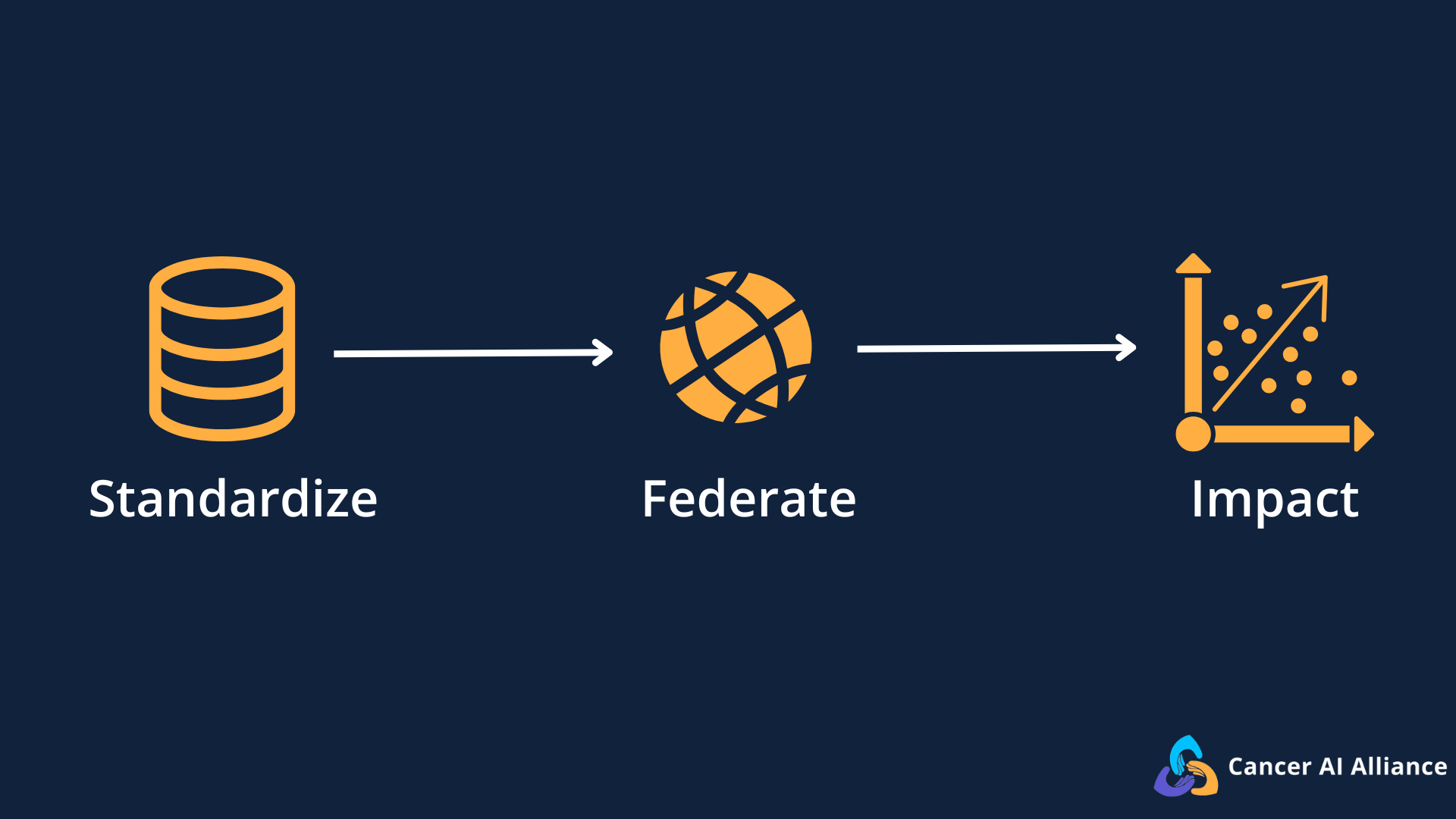
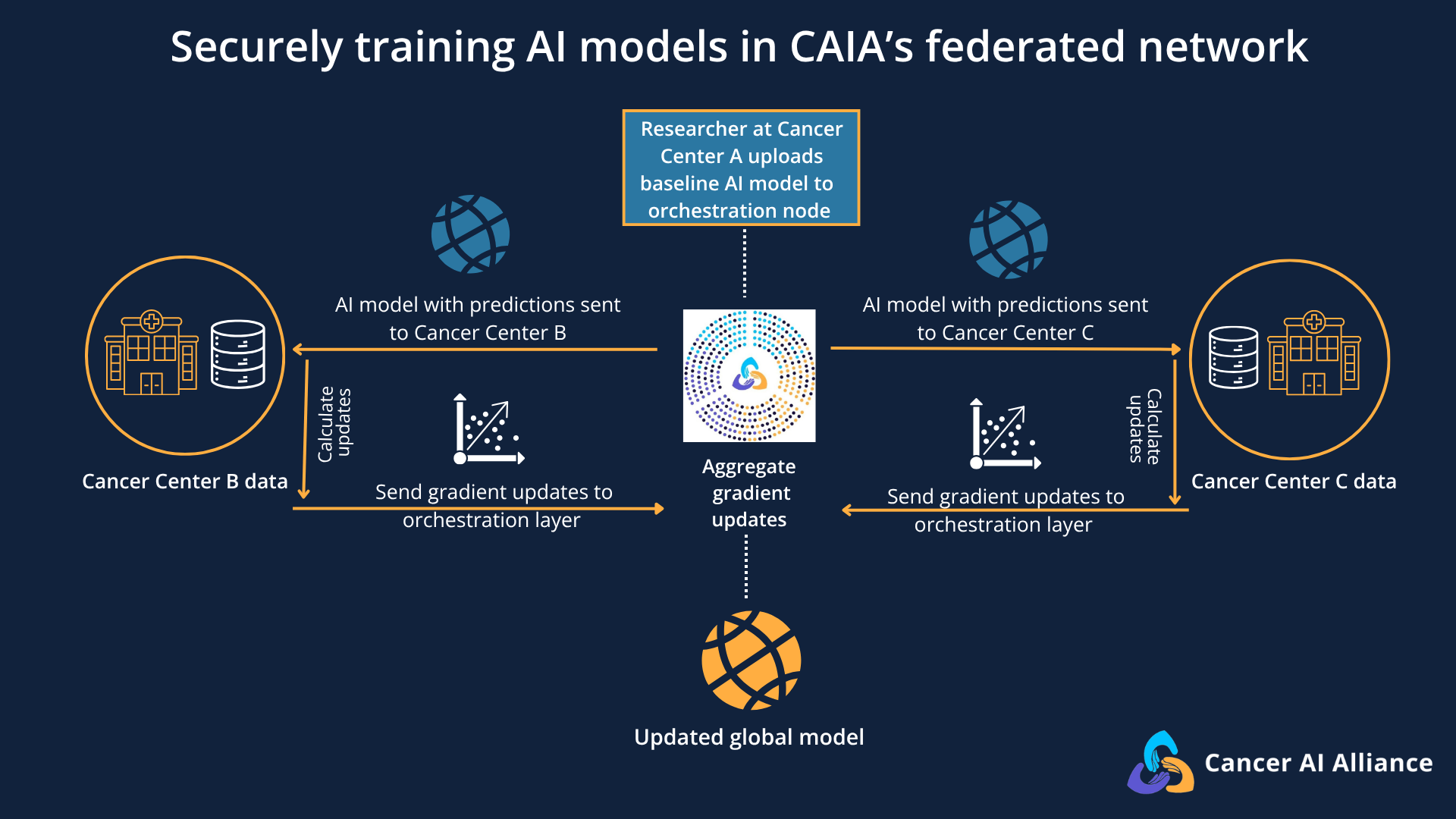
CAIA solves this by using federated learning. Instead of moving patient data to a central location, CAIA has built an orchestration layer that allows AI models to travel to the data. "It’s the sort of exact inverted model," Vasan notes.
“The data is not traveling; it’s more the AI models that are traveling. They go to the data, learn from it, and move to the next one.”
CAIA enables a range of cancer research projects
Vasan points to two specific projects currently being piloted at Johns Hopkins that illustrate the sheer range of CAIA’s federated learning approach:
Researchers like Dr. Alexis Battle and Dr. Mathias Unberath are tackling the challenge of "patient trajectories" and understanding the myriad ways cancer progresses over time. As Vasan explains, while the problem is broad, the solution requires a "ton of data" because the AI must learn from thousands of individual patterns that may only occur in a few patients at a time.
By "carving out" this massive dataset into smaller, highly specific bins, the models can be trained to recognize these subtle patterns without losing accuracy. Additionally, having data that spans multiple institutions is critical for ensuring the findings are generalizable and free from the bias that often exists when looking at a single hospital's population. This scale can be helpful in building a more precise, predictive tool for future patient care.
CAIA’s scale is also important for studying diseases where data is scarce. Dr. Karisa Schreck is leading a project focused on a specific type of brain cancer involving an IDH (short for Isocitrate Dehydrogenase) gene mutation. Because this condition is quite rare, any single hospital might only have a few dozen patients to study, making it difficult to draw statistically significant conclusions about new therapies.
By working with de-identified data from CAIA’s participating institutions, Dr. Schreck can aggregate the collective insights of the nation’s leading cancer centers. This allows her to move beyond small sample sizes to understand exactly who is responding to these new treatments and what specific factors predict a successful outcome.
These projects are powerful examples of how CAIA’s federated network enables researchers to tackle specific clinical questions that would be difficult to answer in isolation.
Unlocking interdisciplinary collaborations in cancer research
Collaboration at CAIA doesn’t stop at the institutional level. It’s also interdisciplinary. By pairing clinical oncology expertise with systems engineering and machine learning expertise, CAIA is broadening how computer science is applied to cancer research.
Vasan highlights his work with Professor Alexis Battle, who was instrumental in the founding of the Cancer AI Alliance. She leads the Malone Center for Engineering in Healthcare at JHU.
Vasan notes that engineering colleagues like Dr. Battle and Mathias Unberath have shifted his perspective on research. They are utilizing "systems engineering thinking" to develop broad, generalizable solutions for big swaths of medical problems. This approach allows them to identify patterns in patient trajectories, ensuring that the tools they build are scalable across different types of cancer.

Drs. Vasan Subramanian and Alexis Battle alongside their CAIA team members
A predictive and proactive vision of care
Vasan’s vision for the future is focused on a fundamental shift in how care is delivered. Currently, medicine is largely reactive, generally starting when a patient feels ill, with screenings happening at set time intervals rather than when a patient actually needs them.
"If we can really learn from all the data we have, we can make care a lot more predictive, proactive, and preventative," Vasan explains. Ultimately, the goal is to eliminate "unwanted variation" in care. Whether a patient is in a major city or a rural area, AI could be used to ensure that every individual receives consistent, expert, and precise care. CAIA’s aim is to enable the development of such powerful and specialized models using the power of our federated infrastructure:
“Each institution can do their best, but only when we have the power of all the [federated] data and expertise across institutions can we really tackle these types of transformative challenges.”
If you’d like to learn more about CAIA, subscribe to our newsletter for updates and follow us on LinkedIn and X.