Training AI Models securely in CAIA’s privacy-first federated network
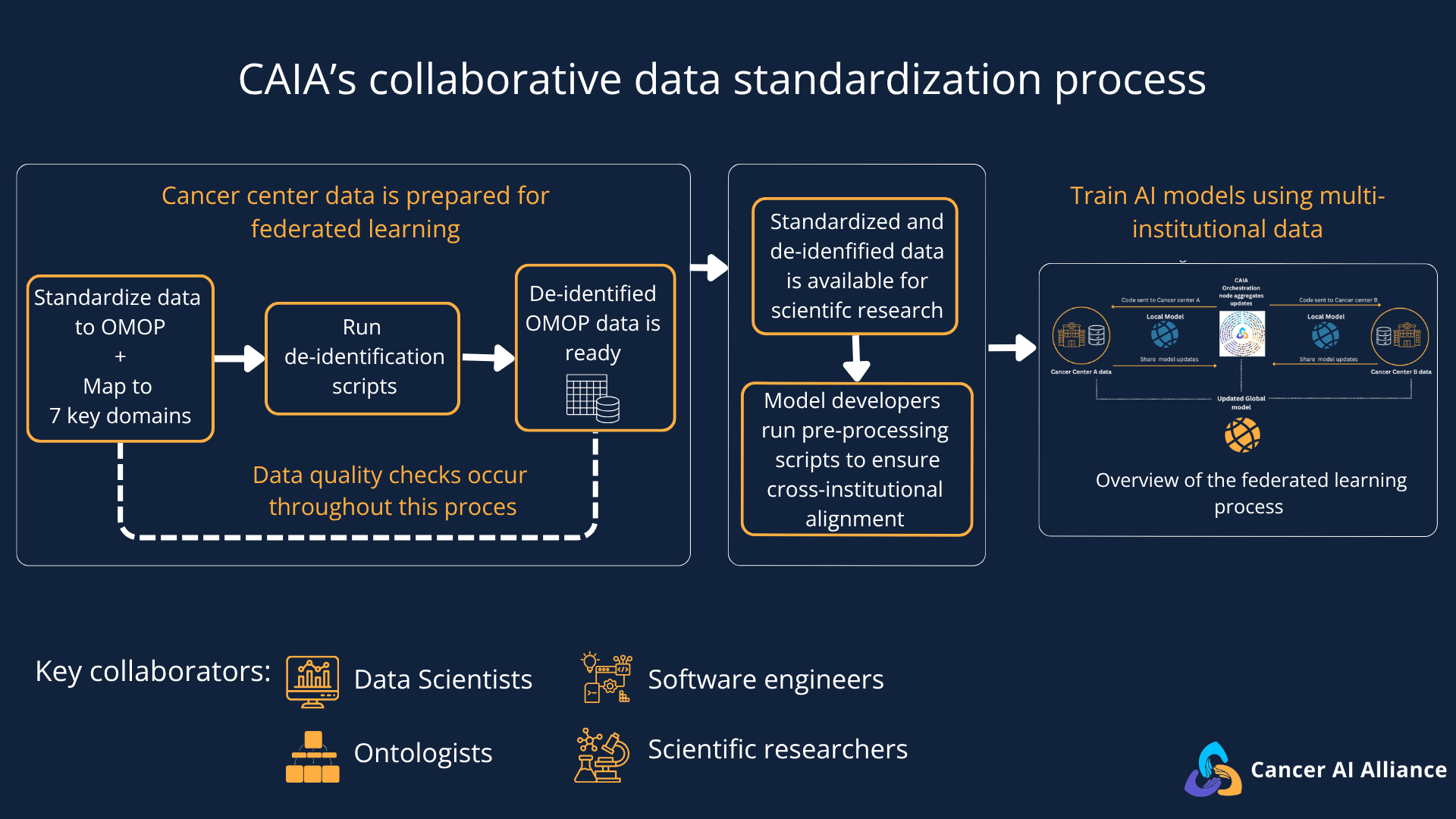
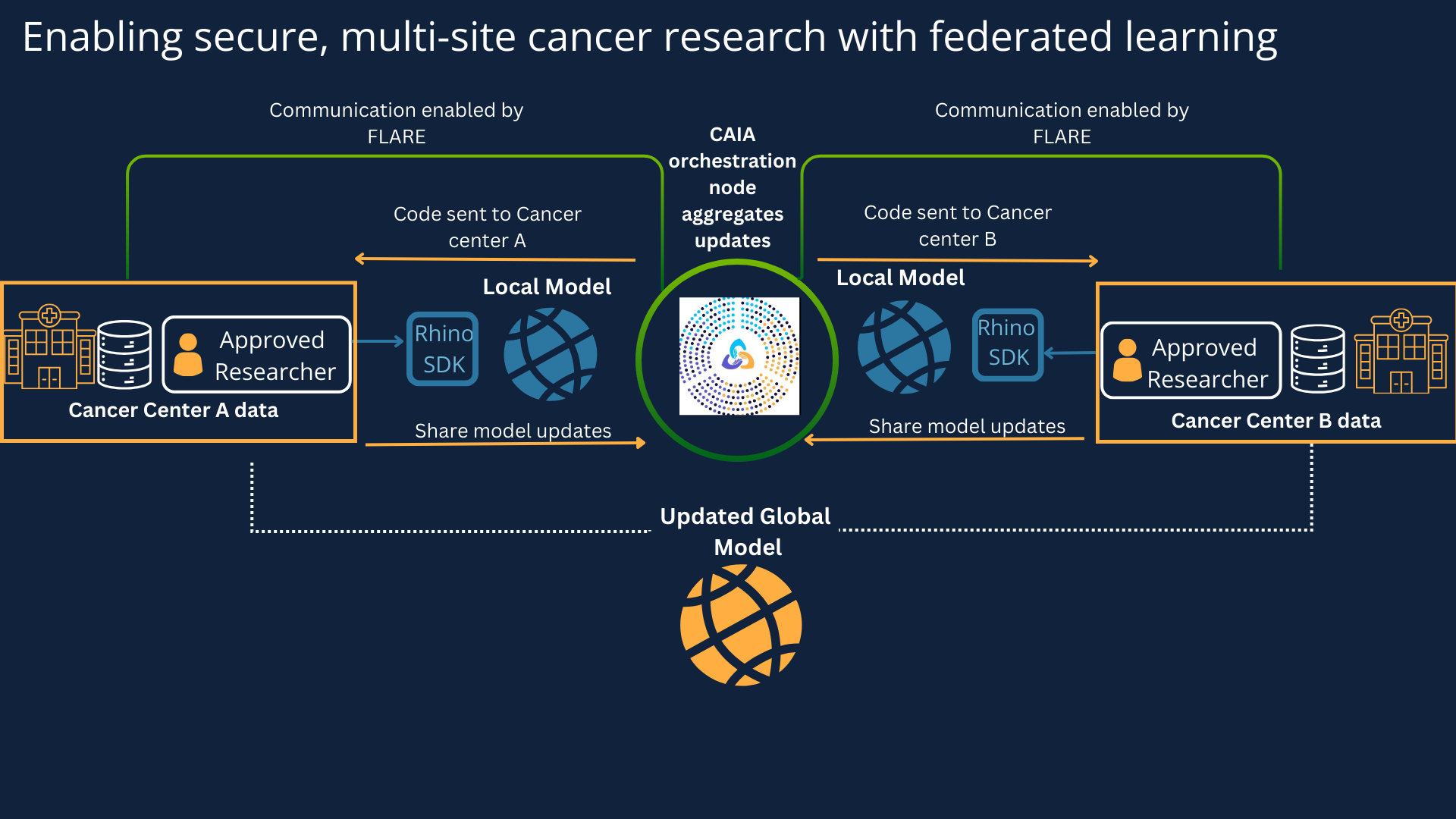
CAIA's federated learning platform was built from the ground up with privacy as a core principle and includes multiple layers of privacy preservation in its infrastructure. Cancer centers are the chief stewards of their patients' data, providing standardized, de-identified data for AI training. All data de-identification and standardization work occurs internally at the cancer centers, ensuring that no one outside the centers has direct access to sensitive clinical records.
Federated learning augments researchers' efforts by training AI models on these de-identified, standardized datasets from multiple cancer centers and sharing updated insights across a broader network.
Gradients are one common type of update shared during the federated learning process. These are mathematical representations that AI models use to improve their predictions about a scientific question or hypothesis of interest to researchers. A gradient tells an AI model how to adjust its internal calculations based on local data patterns without revealing the underlying data.
In this blog post, we’ll take a closer look at the role of gradients and how they help AI models learn in CAIA’s federated network. It is worth noting that gradients are just one type of update that can be returned to researchers. Examples of other types of responses include descriptive summaries such as the total number of patients matching specific criteria across the network (e.g., “the total number of patients over 70 who underwent surgery”).
What are gradients?
To better understand how gradient updates work, imagine you are driving somewhere with guidance from a GPS. To provide you with the most direct route, the GPS doesn’t need to know where you have traveled before or how you got there. To get you where you need to go now, it needs updates on current traffic conditions so it can provide you with the best directions possible. In this context, other cars on the road act as individual edge nodes; each car provides updates on local traffic conditions (such as the speed at which it is currently traveling). These updates are sent to a central system that provides your GPS with an updated summary of traffic conditions without revealing where other drivers are going or their exact current locations.
Similarly, in federated learning, each cancer center's edge node acts like an individual car in the network. The node calculates gradients based on local patient data and sends only those summary updates back to the global model.
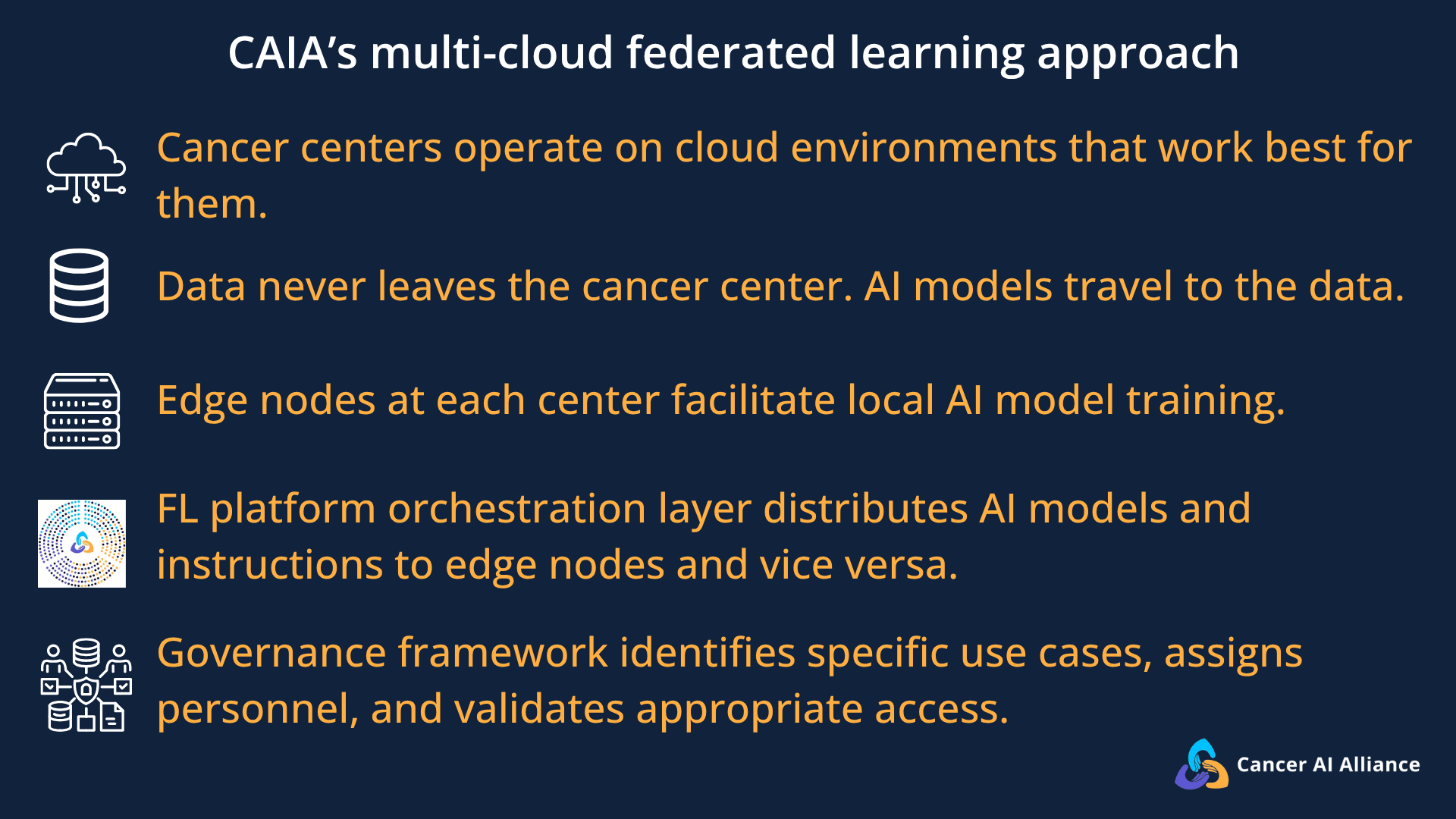
The data never leaves the cancer center.
How does federated learning work at CAIA?
Consider this: At Cancer Center A, a researcher wants to study 1-year treatment outcomes for esophageal cancer in patients over 70. Specifically, they want to know whether a combination of radiation and surgery improves treatment outcomes compared to radiation alone for this group. However, Cancer Center A only has roughly 500 de-identified records about patients over 70 with esophageal cancer.
This poses two challenges:
The number of patients in this specific group limits researchers’ ability to make robust predictions about treatment outcomes.
Center A’s data may only reflect local patient demographics and treatment standards, which may make AI models less accurate when applied to broader populations.
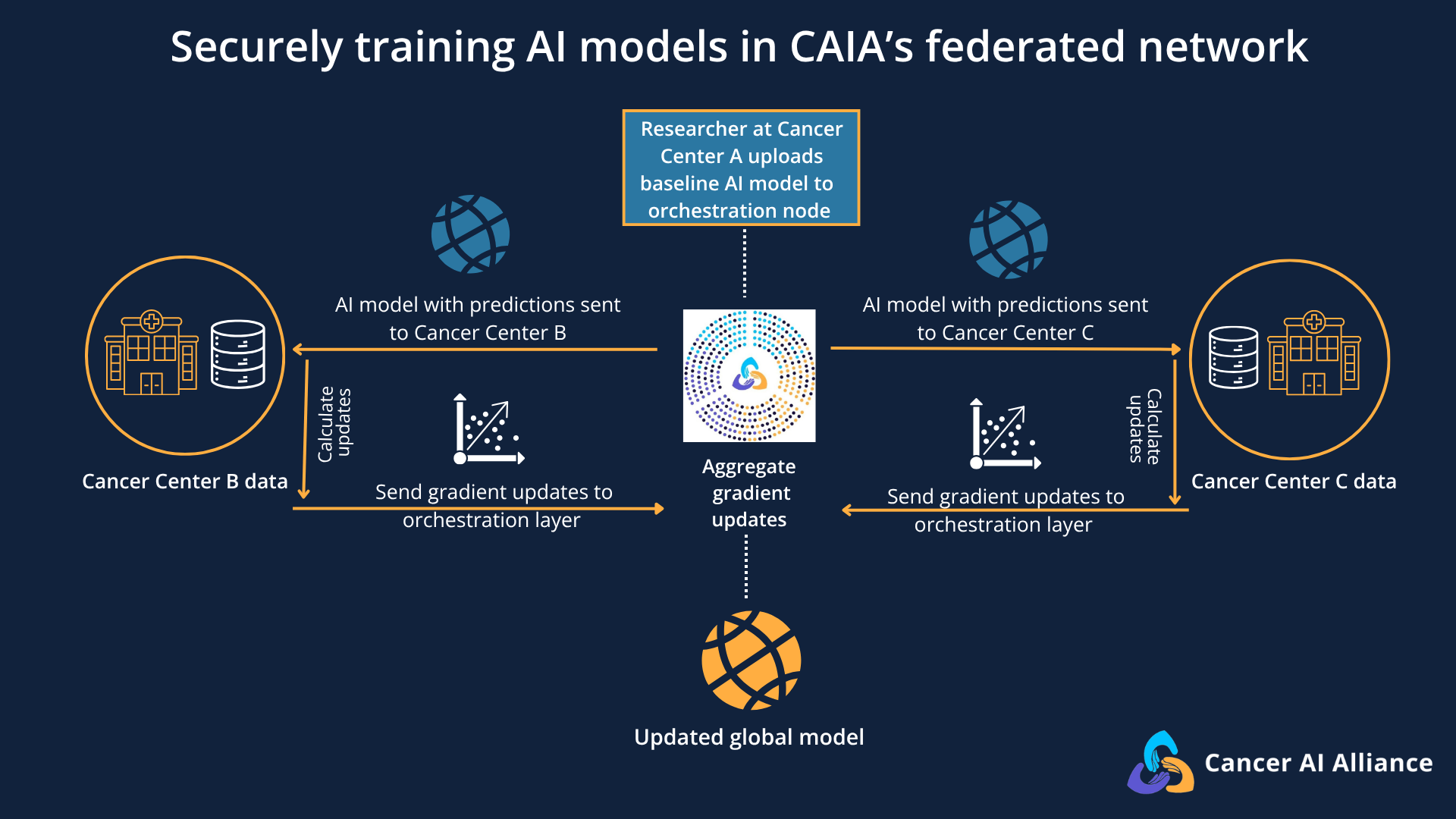
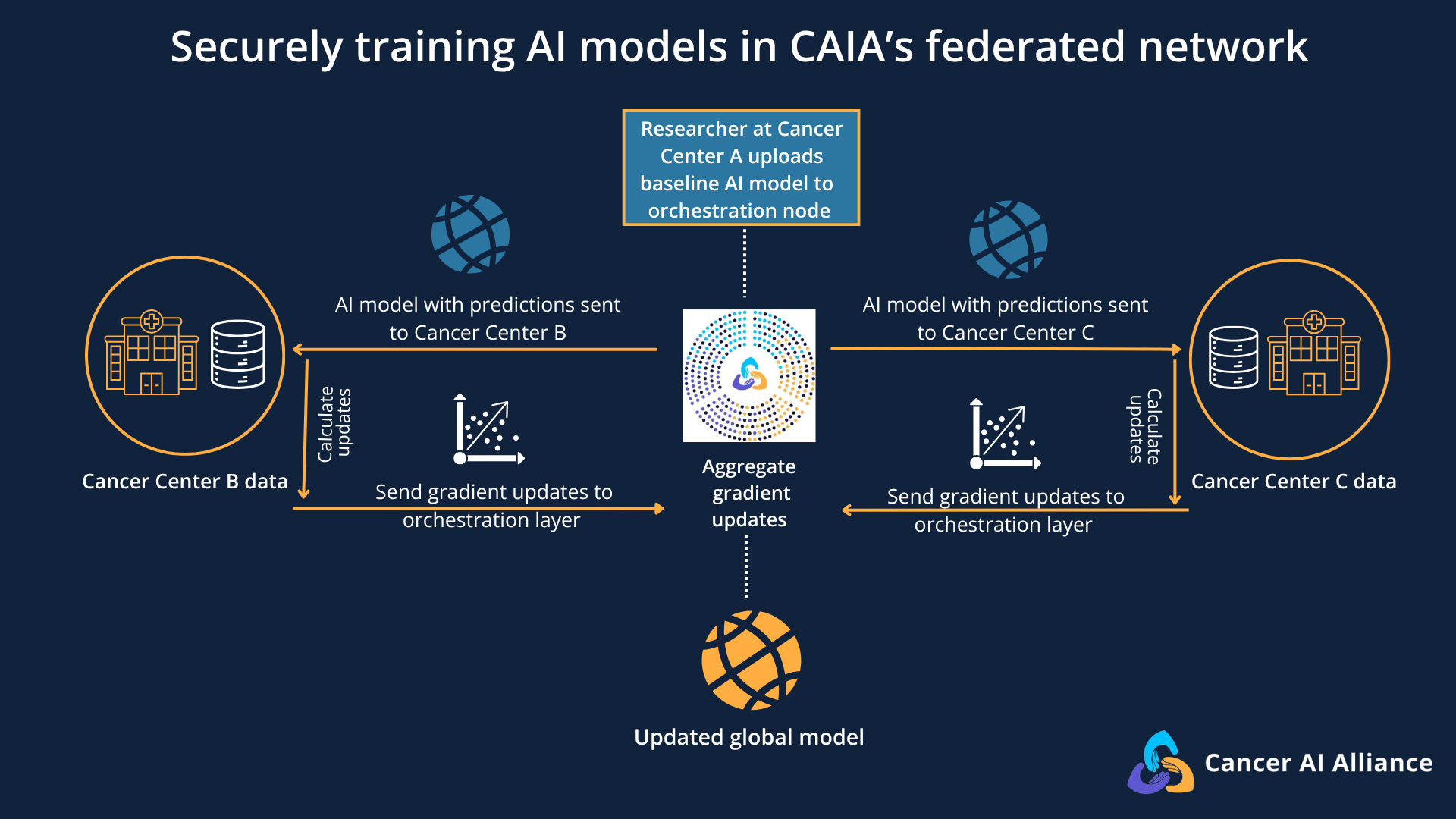
Assume that Center A is part of CAIA’s federated learning network. The researcher uploads a baseline AI model to CAIA’s federated learning platform with initial predictions. The CAIA orchestration layer transmits this baseline AI model containing the researcher’s calculations and training instructions to secure edge nodes installed at participating cancer centers across the network.
Federated learning at the edge
Cancer Center B has roughly 650 de-identified electronic health records about patients over 70 with esophageal cancer.
These records are available at the edge node installed by this cancer center for federated learning. The baseline AI model cannot access Cancer Center B’s data beyond what is made available at the node.
During this local training process:
The AI model takes what it learned up until this point and compares those learnings with the de-identified data at the edge node.
Its baseline predictions are assessed against the treatment outcomes available in this dataset.
It calculates gradients: mathematical updates about how much weight to give to surgery versus radiation for this specific patient demographic.
Instead of sending any individual data back, Center B sends only these mathematical updates representing what the model learned.
How cross-institutional federated learning insights are combined
Imagine that the AI model repeats the federated learning process at Cancer Center C, which has another 1200 de-identified records available at its edge node reflecting a different care setting and patient population.
The model routed through CAIA’s orchestration layer mathematically blends Center A's gradients (from its 500 patients) with Center B's gradients (from its 650 patients) and Center C's gradients (from its 1200 patients).
By combining these gradient updates, the baseline model is now a smarter global model that has learned from hundreds of esophageal cancer cases across the country in patients over the age of 70, and is equipped to make better predictions about 1-year treatment outcomes.
More importantly, the clinical data remains safely in the care of the respective cancer centers.
This global model can then be sent back to each of the edge nodes for another round of federated learning until there is enough confidence that the updated model has sufficiently learned the patterns across the Alliance.
How federated learning accelerates cancer research
Federated learning allows CAIA’s network of cancer researchers to build better, data-driven models to answer many important questions, such as how specific groups of patients might respond to complex treatments. By securely connecting data across multiple institutions, researchers gain access to far more diverse insights than any single institution could provide.
Finding enough rare or specific cases can take a long time at a single cancer center. With federated learning, researchers can transform data into actionable insights more quickly.
If you’d like to learn more about CAIA, subscribe to our newsletter for updates and follow us on LinkedIn and X.